
Patient education · English edition · October 29, 2026
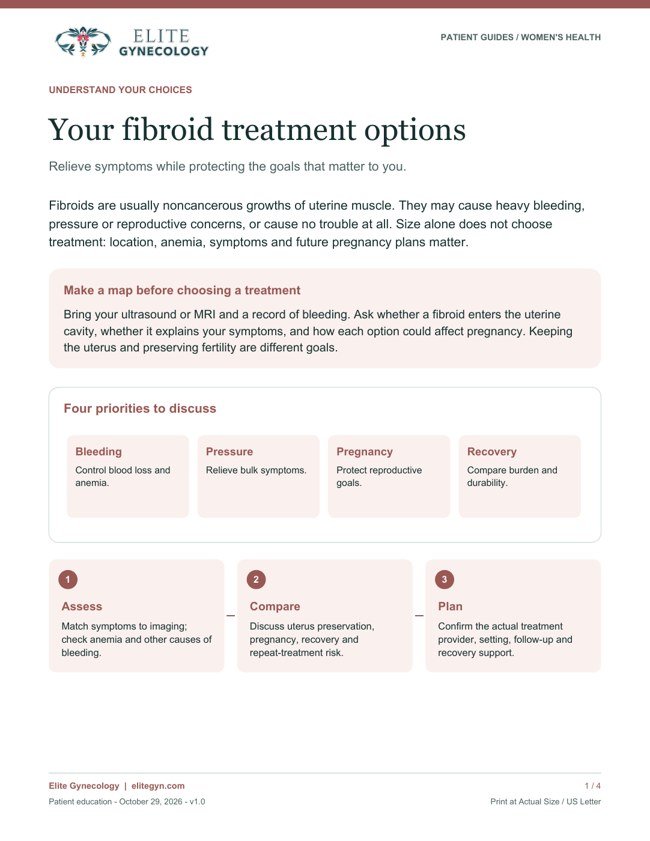
Your fibroid treatment options
Relieve symptoms while protecting the goals that matter to you.
Fibroids are usually noncancerous growths of uterine muscle. They may cause heavy bleeding, pressure or reproductive concerns, or cause no trouble at all. Size alone does not choose treatment: location, anemia, symptoms and future pregnancy plans matter.
Make a map before choosing a treatment
Bring your ultrasound or MRI and a record of bleeding. Ask whether a fibroid enters the uterine cavity, whether it explains your symptoms, and how each option could affect pregnancy. Keeping the uterus and preserving fertility are different goals.
Compare the options
| Option | Why consider it | What to weigh |
|---|---|---|
| Observation | Avoids a procedure when symptoms are mild or absent. | Needs a follow-up plan. New bleeding after menopause requires evaluation rather than assumption. |
| Medicines / hormonal IUD | Can reduce bleeding; iron treats associated iron deficiency. Tranexamic acid is a nonhormonal option for some patients. | These usually do not remove fibroids or solve substantial pressure. A distorted uterine cavity may preclude an IUD. |
| GnRH-based medicines | Can suppress bleeding and shrink fibroids, sometimes as a bridge to a procedure. | Duration limits, bone effects and other risks require monitoring; symptoms may return after stopping. Some combinations carry clot risks. |
| Myomectomy | Removes selected fibroids while retaining the uterus; often central when future pregnancy is a priority. | Hysteroscopic, laparoscopic, robotic or open approach depends on anatomy. Bleeding, scar formation and later fibroids remain possible. |
| Uterine fibroid embolization (UFE) | A catheter procedure reduces blood supply so fibroids shrink; avoids surgical removal of the uterus. | Recovery cramps, infection, ovarian effects and further treatment are possible. Future pregnancy needs specialist counseling. |
| Radiofrequency ablation / focused ultrasound | Treats selected fibroids without removing the uterus. | Suitability and access vary; long-term and pregnancy evidence differ by method. |
| Hysterectomy | Definitively prevents fibroid recurrence by removing the uterus. | Ends the ability to carry a pregnancy. Recovery and surgical risks vary; ovary removal is a separate decision. |
Our office approach
How our practice provides care, alongside the general options above.
The least invasive effective path
We prioritize effective care with less procedural burden when it fits your diagnosis, anatomy and goals. Our interventional service invests in advanced imaging for targeted procedures; equipment and manufacturers change over time. Imaging, contrast, radiation and anesthesia are discussed for your particular treatment.
Focused ultrasound expertise
Our practice provides modern in-office ultrasound for urology, gynecology and interventional care. Experienced, dedicated ultrasound technologists focus on these specialties, with much of their work in urology. An in-house radiologist interprets images, and treating physicians trained in image interpretation also review relevant studies. Ultrasound uses no ionizing radiation; CT, MRI or other tests may still be needed.
Prompt answers and a clear follow-up plan
We usually generate ultrasound reports and explain the findings and follow-up to patients the same day. Some studies need additional review, and turnaround varies. Ask what the result means and what happens next. Confirm your service and location before visiting.
More of your evaluation in one place
In-office blood collection, urine testing and pelvic ultrasound can reduce separate testing visits when these tests are appropriate. Preparation and result timing depend on the test. Tell us about possible pregnancy, symptoms and previous results. Ask which findings affect your choices and whether any further testing or specialist care is needed.
Questions to ask
- Do my fibroids explain the bleeding or pressure?
- Which options fit a future pregnancy?
- What is the expected recovery and chance of another procedure?
- Which treatments are performed here and which require a referral?
What you can do now
- Record period length, clots, pad use, pressure and effects on work or sleep.
- Ask whether blood counts, iron studies or sampling of the uterine lining are appropriate.
- Do not stop prescribed medicines or blood thinners without a specific plan. Availability of each procedure must be confirmed.
When to seek urgent care
Very heavy bleeding with faintness, chest symptoms or shortness of breath needs urgent care. New bleeding after menopause, fever or severe pelvic pain warrants prompt assessment.
Further reading and sources
- womenshealth.gov — clinical reference 1
- www.fda.gov — clinical reference 2
- www.radiologyinfo.org — clinical reference 3