
Patient education · English edition · October 29, 2026
Choosing an IUD
Long-lasting birth control, chosen around your priorities.
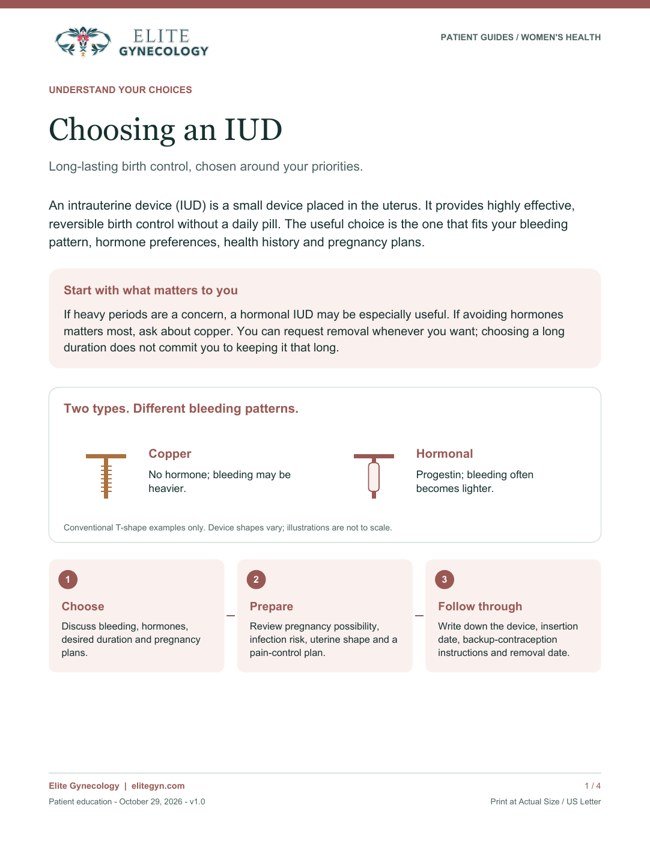
An intrauterine device (IUD) is a small device placed in the uterus. It provides highly effective, reversible birth control without a daily pill. The useful choice is the one that fits your bleeding pattern, hormone preferences, health history and pregnancy plans.
Start with what matters to you
If heavy periods are a concern, a hormonal IUD may be especially useful. If avoiding hormones matters most, ask about copper. You can request removal whenever you want; choosing a long duration does not commit you to keeping it that long.
Compare the options
| Option | Why consider it | What to weigh |
|---|---|---|
| Mirena or Liletta | Hormonal; pregnancy prevention for up to 8 years. | Often makes bleeding lighter. The heavy-menstrual-bleeding indication has its own 5-year duration and eligibility; early spotting is common. |
| Kyleena | Hormonal; pregnancy prevention for up to 5 years. | Lower hormone content than 52-mg devices. Irregular bleeding may occur; it is not the same heavy-bleeding treatment indication. |
| Skyla | Hormonal; pregnancy prevention for up to 3 years. | A shorter-duration hormonal option. Discuss bleeding changes, insertion comfort and availability. |
| Paragard | Copper; pregnancy prevention for up to 10 years. | No hormone. Periods and cramps may become heavier, especially at first; copper allergy or Wilson disease can rule it out. |
| Miudella | Copper; FDA-approved pregnancy prevention for up to 3 years. | A newer option. Confirm local availability and trained insertion access; approval does not mean our office stocks it. |
Our office approach
How our practice provides care, alongside the general options above.
The least invasive effective path
We prioritize effective care with less procedural burden when it fits your diagnosis, anatomy and goals. Our interventional service invests in advanced imaging for targeted procedures; equipment and manufacturers change over time. Imaging, contrast, radiation and anesthesia are discussed for your particular treatment.
Focused ultrasound expertise
Our practice provides modern in-office ultrasound for urology, gynecology and interventional care. Experienced, dedicated ultrasound technologists focus on these specialties, with much of their work in urology. An in-house radiologist interprets images, and treating physicians trained in image interpretation also review relevant studies. Ultrasound uses no ionizing radiation; CT, MRI or other tests may still be needed.
Prompt answers and a clear follow-up plan
We usually generate ultrasound reports and explain the findings and follow-up to patients the same day. Some studies need additional review, and turnaround varies. Ask what the result means and what happens next. Confirm your service and location before visiting.
More of your evaluation in one place
In-office blood collection, urine testing and pelvic ultrasound can reduce separate testing visits when these tests are appropriate. Preparation and result timing depend on the test. Tell us about possible pregnancy, symptoms and previous results. Ask which findings affect your choices and whether any further testing or specialist care is needed.
Questions to ask
- Which option fits my bleeding and uterine anatomy?
- What pain relief can you offer during insertion?
- When am I protected, and do I need condoms or backup for 7 days?
- How can I arrange removal or a change of method?
What you can do now
- Tell us about unexplained bleeding, pelvic infection, breast cancer, medicines and allergies. A cavity-distorting fibroid may change suitability.
- Plan for cramps or spotting after placement. Ask what to expect and whom to contact.
- IUDs do not prevent sexually transmitted infections. Condoms may still be needed. Never try to remove an IUD yourself.
When to seek urgent care
Seek prompt care for severe or worsening pelvic pain, fever, very heavy bleeding, a positive pregnancy test or suspected expulsion. If strings change or the device may have moved, use backup and contact the office.
Further reading and sources
- www.cdc.gov — clinical reference 1
- medlineplus.gov — clinical reference 2
- www.paragard.com — clinical reference 3
- dailymed.nlm.nih.gov — clinical reference 4